
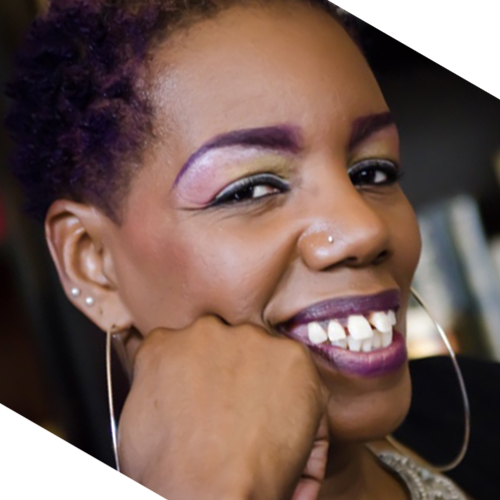

No matter when an individual joins the LGBTQ+ community through self-acceptance, everyone has an opportunity to make an impact that resonates. Heidi Hemphill Samples is one such individual. Born in Toledo, Ohio, reared in the suburbs of Cincinnati and landing in Charlotte in 2018, Samples continues to make her mark in a community that might otherwise feel forgotten. During this interview, Samples spoke to us about her journey into Charlotte’s LGBTQ+ community, and her love and interest for all things she identifies as Sapphic.
From a Lake Norman area townhouse she refers to as her peaceful sanctuary, Samples shared her insights on living, loving and hosting events that draw crowds of folks seeking creative connections and new friendships.
L’Monique King: What brought you to Charlotte?
Heidi Hemphill Samples: My late husband’s job. His career had taken us around the country. We moved from Cincinnati to Greenville, North Carolina, from there to Huntersville and from there to West Des Moines, Iowa, and then back to Charlotte in 2018.
LMK: How long were you married to your husband?
HHS: We were together for 34 years and married for 27 years when he passed. He died two days before our 27th wedding anniversary. I met him when I was 18, we dated for eight years before we got married, had our first baby in 1996, our next in 1999, another in 2000 and our last one in 2004. We have two girls and two boys and interestingly both of the girls are part of the LGBTQ+ community.
LMK: How do you identify?
HHS: As lesbian.
LMK: What’s your favorite thing about Charlotte?
HHS: The water. I live in the Lake Norman area and love the proximity to the beach and the mountains. Being able to get to Savannah and Charleston pretty quickly is also a draw. I used to be able to say the cost of living and a few other things that just aren’t true about Charlotte anymore. There were flowers and not toll roads when I moved here in 2006; now the flowers are gone and traffic is abysmal, especially on 77.
LMK: What’s Sapphic Collective and your connection to it?
HHS: I began planning storytelling and singles events in order to connect communities of different ages, races and backgrounds. Sapphic Collective began because I wanted to connect with my peers – of similar life experience; women loving women of a certain age. I founded the group for 40+ sapphics (women who love women) because I wanted to connect with people who were going through some of the same things I was going through at this stage in life. Things like menopause, adult children, aging parents, retirement, medicare and all the stuff women go through as you are aging.
The group is very diverse, the collective gives us an opportunity to have gatherings and intimate conversations. It gives older lesbians and sapphics an opportunity to be grounded, seen and valued. As we get older people don’t look at us the same – women who are aging in the U.S. are not valued as they were in their youth. Because of that, I’m [also] looking at establishing a mentoring program at some point that would pair younger and older sapphics. There may be [seniors] who did or did not have children who may want a connection with a younger person and younger sapphics who may not have connections with biological parental figures or guardians who may also want that connection.
LMK: Did you experience any challenges as a lesbian who came out later in life?
HHS: Initially there was a perceived challenge. When I first came out, there was the feeling that being femme either meant being invisible in the community or being mis-identified as a straight woman. It’s the reason why so many of us wear a rainbow ring or something that will make us more visible. But what I’ve learned is that the essence of who I am is still the same, so now I don’t worry about wearing a rainbow ring (or other insignia). I just show up as me – as my authentic self – and that’s going to have to be enough.
LMK: What advice would you offer to lesbians who have come out later in life?
HHS: Study your history. Know your LGBTQ+ history and community terminology. Learn about the people who have come before you. You don’t have to be able to recite dates and times for everything, but know why you’re now able to publicly hold hands with your partner. [And don’t forget] you don’t have to prove anything to anyone or change how you dress or who you are, just [focus on being] your self.
LMK: Your efforts in engaging community have clearly not gone unnoticed. What would you say is your greatest accomplishment in life thus far?
HHS: My children. I was really blessed to be able to be a stay-at-home mom with all four of my children. I also had an amazing husband who worked from home, was involved in the day to day and typically made time to be [back for] dinner nightly when he traveled for work. So, though our lives were very busy with all their activities – a lot of women can’t for whatever reason stay home full time with their children. As a Black woman it was rare that I would see other Black women at play dates, moms groups, libraries, children’s museums; the things you do when they are little to keep them entertained, educated and occupied.
LMK: What do you fear the most?
HHS: Leaving my children with no parents. Them having another [parental] loss, as young as they are, and being in the world without their parents. Our children were the center of our lives. They all have emotional intelligence, financial resources and live independently, but still, I’m 58 and still have both of my parents while they lost their father during COVID, a very scary time.
LMK: What’s the dumbest thing you’ve ever done?
HHS: I called myself trying to dye my eyebrows and got this Just For Men beard tint. I didn’t read any instructions, didn’t look online or anything – I just put it on and all around my eyebrows. I ended up looking like Groucho Marx and had to go to work two days later. <Raucous laughter> I tried everything to get it off and was finally successful, but it took numerous attempts and lots of different chemicals to get it off.
LMK: When you’re not making crazy cosmetic errors, what tickles you to the point where you’d laugh during a funeral?
HHS: Somebody farting or any loud noise when things are supposed to be quiet <giggling>.
LMK: What’s the last lie you’ve told?
HHS: That I’ve got it handled when I should have admitted I was overloaded. I’ve learned that being dependable also means being honest about your bandwidth and asking for support before things become stressful. Otherwise, I don’t typically lie; I’m pretty transparent. It’s easier than trying to remember what you’ve said. I’m a Sagittarius, we’re generally told we’re too blunt.
LMK: What would you say is your greatest pet peeve?
HHS: <Without hesitation> Pets on furniture. I would rather not be on furniture where your dog’s butt has been.
LMK: What would people be surprised to know about you?
HHS: That I completed a triathlon. I found a group called Try It For Life, it’s a women’s only triathlon training group. You train for about 12 weeks, go through a mock trial and then the race. I was an athlete in 2009 and then went on to help train new athletes and eventually became a board member. I lived in Huntersville at the time where the training took place. It was a very empowering experience. It inspired many women who previously were not engaging in athletics to then go on to acquire higher education degrees, apply for promotions, finally leave toxic partners, whatever. There were women who previously had athletic experience, but none of the women had ever competed in a triathlon before; it was the requirement.
LMK: Before you go, would you leave a word of advice to our youth?
HHS: If you cannot go to college, get a trade or a certificate. Move away from your hometown, learn a new language, get back to what you loved doing as a little kid and find joy in the little things.
This story is brought to you by Rosedale Health and Wellness and Dudley’s Place.
