
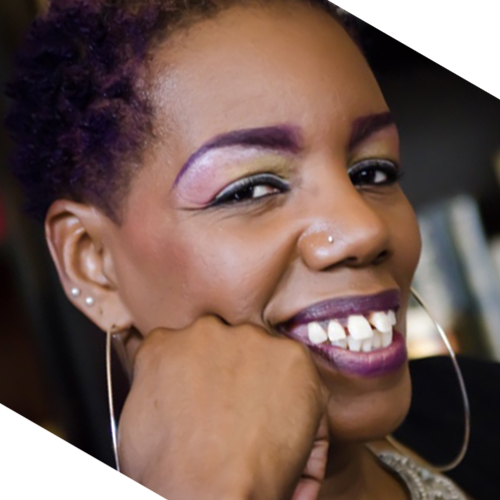

Naomi Dix is both an advocate and entertainer.
A resident of Durham, North Carolina, Naomi Dix is both a popular performer and a homebody (when time allows) who can attest to the fact the city she calls home boasts a diverse population that includes a mix of ethnicities and cultures. It’s also a global center for information technology, biotechnology, pharmaceuticals, and medicine.
An accomplished drag artist, she makes her presence felt through stage performance, public health advocacy and entrepreneurship. During this interview, Dix shares some revelations with us about what it’s like making a career as a multi-ethnic performer in a world that’s not always as welcoming as it should be.
LMK: Are you originally from Durham?
ND: Yes. I was born and raised in Durham. I lived in Raleigh for about 10 years and moved back to downtown Durham almost 10 years ago and I’ve been in Durham ever since.
LMK: Seems like you enjoy the area. What’s great about Durham?
ND: I think we all take where we grew up for granted. But when I became older and had lived other places, I developed more of an appreciation for Durham, the historical value and the Queer community that the city has. I think many people hear Durham and just think south. But Durham has a strong and present Queer community that’s very relevant.
LMK: Is there someone special you share your life and home with? Are you partnered?
ND: I am and have been with my husband now for almost 10 years. He’s a film editor and has been in North Carolina on and off for 15 plus years. He likes to be in the background, we’re both extremely private people who enjoy being behind the scenes. I love that ginger Irishman more than anything.
LMK: What a blessing to spend your life with someone you’re so endeared to. If today was your last day and you were asked to write your own headstone inscription, what would it say?
ND: Had a good time.
LMK: Do you have any siblings?
ND: Yes, an older sister. She’s 15 years older than me – we were extremely close as I was growing up. She went out of her way to take care of me, even when she went to college and traveled with her friends; she always made me a major part of her life, including after marriage and having children. She was a very good big sister. Unfortunately, I haven’t spoken with her in almost eight years. She doesn’t agree with my Queer identity, me being married to someone of the same sex or my decisions in life regarding my involvement with the Queer community. But the wonderful thing about the Queer community is that we support one another and have access to having chosen family.
LMK: Speaking of identity and support, how do you identify?
ND: My mom is Dominican, Black and Jewish. My father is Puerto Rican and Chinese. I identify as Afro-Latinx.
LMK: Wow! Sounds like meals must be interestingly delicious with such cultural fusion going on. Do you cook?
ND: I love southern food, so that’s what I mainly cook. My husband [now] has a behind because of my cooking <chuckling>. He always says I’ve reignited his taste buds. Before me he just put salt and pepper on everything. But now he’s become accustomed to well-seasoned food with spices. I cook all the time and I cook everything from scratch. I’m very in touch with my southern roots, more than my Latin. My family is the Spaulding family – they founded Durham’s Black Wall Street and NC Mutual Life Insurance in 1898; the first and oldest Black owned life insurance company in North Carolina.
LMK: What’s living in the south been like for you as a multi-ethnic person of color?
ND: Growing up was confusion as to what beauty was because the only sense of beauty I had [from media] was white and whiteness. People of color weren’t on TV. So, my mother, who has a degree in African American Studies, found it very important to teach me that beauty lies within everyone, no matter what the color of their skin. She taught me that my curly hair, features and caramel colored skin were beautiful – even though beauty itself is subjective. Today, I think I’ve acclimated to the lack of education when it comes to my ethnicity and who I am as a person. When it comes to people asking me, “What are you?” [racially or ethnically] and having questions about the texture of my hair it’s something I deal with every day; and dealt with even more during the ’90s. However, as I’ve become older and representation has become greater, people are starting to understand that not every Latino person looks like Jennifer Lopez or Rickie Martin.
LMK: What’s the source of your livelihood?
ND: I work for a program called Latinos in the South as a Community Outreach and Engagement Coordinator. We’re housed under a larger nonprofit based in New York City, The Latino Commission on AIDS. The work we do is centered around giving southern Latinos access to health care; specifically, health care surrounding HIV/AIDS intervention and prevention. I take on more of a direct role in the coordination and organizing of our annual conference; Encuentro – which means gathering in English. It’s very rewarding work. Probably the most rewarding work I’ve ever had.
LMK: What’s your involvement in Durham pride?
ND: I was one of two Directors of Durham Pride (previously known as North Carolina Pride until 2018) since 2021 and just stepped down two months ago. My main focus was entertainment, concerts, community outreach and engagement. I was the primary point of contact when it came to the facilitation of any relationship between Durham Pride and local and international artists. My responsibilities included staying on budget and making sure the representatives of the artist weren’t taking advantage while arranging all concert and festival bookings.
I stepped down because I needed to be more present in my personal life. So, though I really enjoyed the position, I also decided to open up the very first (in over 30 years) a trans-gay-queer night club: Club Era. We opened June 1st in conjunction with National Pride Month. Our opening was extremely successful, we sold out our door tickets within five minutes. It was great.
My idea was to create a space that really gave vibes of New York, Chicago, San Francisco and Berlin. It’s a basement club but it’s not just a club it’s also a bar. Our people are so diverse – we have [young] patrons and people in their 50s, 60s and even 70s.
LMK: Entertainment seems to be in your blood. What led you to become a drag performer?
ND: A college friend and I used to go to local drag shows. I became annoyed that I didn’t see a representation of myself in the drag world, Then I went to Pin Hook and saw Vivica C. Coxx; a beautiful, red headed Black queer woman.
LMK: Knowing how successful you’ve been would you share a little about your beginnings in the drag world. Have you always been welcomed in the drag scene?
ND: No, but I’ve never been very concerned about other people or their opinions of me. Not to say I’ve never taken someone’s view or bigotry to heart. But I have always marched to the beat of my own drum – doing what I want to do and feel comfortable with. But no, not always welcomed, especially in the south. I got paid less [than white performers], had my name miss pronounced and was not always booked. I had to earn a level of respect by standing firm in who I am as a performer and a professional. I have always tried to present myself in the most professional manner because I wanted to be taken both seriously and professionally.
Today, I’m not dealing with the issues I dealt with when I started, but I think as a person of color (whether we are artists or not) we’re always going to have to deal with some of that.
I often think about Dorothy Dandridge and Beyonce who still, with all their talent, had to deal with these issues of always having to prove themselves.
Whether we are lighter or darker [in complexion], colorism affects us as POCs in general. I have been a part of that – feeling as though my success in art is only because I am of a lighter complexion. And though that may be a part of that, I scowl when I hear this because it’s insulting to be accused of being successful based upon my skin tone versus my talent and skill set.
LMK: Sounds like you have a full life. How do you deal with stress?
ND: I have a therapist and a partner who is extremely supportive of me. But coming to the realization of my worth has really helped me deal with stress. I think most of our stress comes from us allowing people’s bad behavior to reflect upon us and in our lives.
LMK: Do you have any self-care routine?
ND: Most definitely. Doing drag for almost 11 years (8-10 shows a week) added a lot of stress. I had to learn what self-care looks like. For me, it’s having boundaries, keeping my personal and professional life separate, allowing myself to make mistakes and being emotionally present for my husband and household.
LMK: Before we go, would you leave us with a thought or word of advice for our LGBTQ youth?
ND: The fight will never be over. As long as we’re a united front we will only get stronger in making sure that our voices are heard and our faces seen.
