

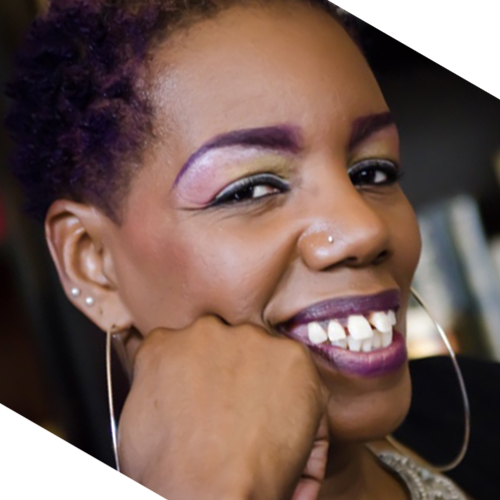

Bethany Corrigan is a DEI warrior with wavy black hair, piercing steel blue eyes and a luminous smile. With a master’s degree in public health and a history of fighting for equality around the globe, queer LGBTQ advocate Corrigan has contributed much to fostering diversity, equity and inclusion worldwide, with a concentrated effort in the Carolinas. During this interview, QNotes gained deeper insight into the identity and life’s work of Corrigan, a Holiday Wish Foundation honoree for the organization’s 2025 Community Impact Award.
L’Monique King: Where are you from originally?
Bethany Corrigan: South Carolina, right over the Buster Boyd bridge. I still live there. People often think I live in Charlotte because I do so much work here, but I’m actually a South Carolina resident.
LMK: What are your pronouns? How do you identify?
BC: My pronouns are they/them. I am nonbinary, femme and demi. In all relationships for me, it’s about respect, how a person lives their lives, their energy, how they interact with others, what their priorities are and how they think.
LMK: Nonbinary femme? That sounds a little oxymoronic: How are you nonbinary but identifying as femme, when the connotation of femme is female associated?
BC: Because femme and masculine are nonbinary in and of themselves. And if we can accept that as a society, culturally we’ll be so much better off. Language is power because it can provide valuable information. However, when we start to become by labels and adjectives that were once helpful to us, we are actually restricting our growth and it becomes harmful. Language is a tool – an ever-evolving tool. Remembering that is important.
LMK: In seeking greater clarity on another of your identifiers, can you explain what you mean when you say “demi?”
BC: To me, demi means that I am only able to enter into any type of relationship where there is a foundation of respect, trust and emotional bond first. There are no automatic connections.
LMK: Thank you for your explanation. On a more serious note, what did you have for breakfast today?
BC: <chuckles> I don’t eat breakfast; I’m fueled by caffeine. I do like cereal though and generally eat it in the middle of the night. Sometimes I just shovel handfuls into my mouth. On rare occasions, I might have it [in a bowl] with oat milk.
LMK: Fruit Loops or Corn Flakes?
BC: Fruit loops, one hundred percent.
LMK: Is there anyone special in your life you might be having cereal with? Are you partnered?
BC: I am. I am married.
LMK: How long have you been married?
BC: Five years. Marriage was not always a priority for me. But the person I married is a social justice warrior and the best human you’ll ever meet – who made the venture of marriage so worthwhile.
LMK: You mentioned your spouse being a social justice warrior. How do you make your livelihood?
BC: I am a public health gender specialist. I work with nonprofits, government entities and social equity systems to identify areas of program expansion, especially as it relates to marginalized communities being left out to planning and benefiting from those programs.
LMK: Any thoughts or concerns regarding the recent presidential election?
BC: My concerns are regarding the way our legislation is moving, regarding our voter rights. In Georgia and North Carolina, we’re seeing a lot of redistricting happening and laws being passed that make it difficult for many groups of people to have their voices heard. That concerns me with any democracy. I’m also concerned about legislation that will harm queer people – especially trans people. The thing about civil rights movements is that people think we’re fighting for a greater piece of pie that’s not deserved – when in fact we’re fighting for the right of all people to have pie. The civil rights movement is protective and fighting for all people.
LMK: When you’re not fighting for equality or educating others on equity and inclusion, what do you do for fun?
BC: I’m a beekeeper. I love it. It’s a matriarchal society. It’s the most beautiful representation of a socialist society and leadership. The Queen takes the ques of what needs to be done based on what’s happening in the hive itself. The workers tell her what needs to be done and she does it, she leads. It’s really powerful. I’ve learned a lot about emotional regulation, community and adaptation within the context of evolving to meet the needs of the now while investing in the future.
LMK: How about self-care? Is there a go-to routine or practice for you?
BC: Beekeeping and being outside in the natural world, that’s very healing for me.
LMK: If reincarnation is an actuality – what would you like to come back as in your next life?
BC: <Long thoughtful pause> A bird maybe. Being human is so emotionally taxing I’d love the freedom of being able to fly. As grateful as I am for my existence and the experiences I’ve had, if given the opportunity to have a [break] in being human I would appreciate that opportunity.
LMK: Book or movie?
BC: Book. I don’t have the attention span to sit through a whole movie. It drives people crazy. I haven’t seen a movie in a theater in about seven years. I haven’t even seen “Wicked” yet, though I loved the play – but the idea of sitting through a three hour movie – I just can’t. And I talk. I was on a date once and they moved two rows back because I wouldn’t stop talking.
LMK: Share another fact most folks might be surprised to know and learn about you.
BC: I like to ride motorcycles. I own a Honda Rebel, it’s cherry red and not too big. Riding my motorcycle or a horse is probably the closest thing to flying for me.
LMK: Sounds cool and for some reason not surprising that you’re finding freedom and comfort in Rebel. We also have an additional fun fact many may not know about, your upcoming Holiday Wish Foundation award. How’d you feel learning that you would be a recipient of this year’s Community Impact Award?
BC: I was so touched. I am very humbled and honored. I think a lot of us have the same gut reaction of, gosh there must be 30,000 more deserving people than me. So many people are fighting for our causes to the extent that we will never know. And that’s the thing about impactful relationships, you don’t always know the impact you’ve had on another person. If there’s one thing we should always strive to do, it is be a person in whose presence others can exist as their authentic self.
LMK: What is Bethany doing 20 years from now?
BC: I would love to say that I’ve put myself out of business, but I would hope that I’m continuing my contribution to the fight – but hopefully in a more progressive state/world. I really hope that in my lifetime there are significant markers of successful progress.
LMK: Is there a thought or word of advice you’d like to leave our readers with, in closing?BC: There is no right way to be you.